
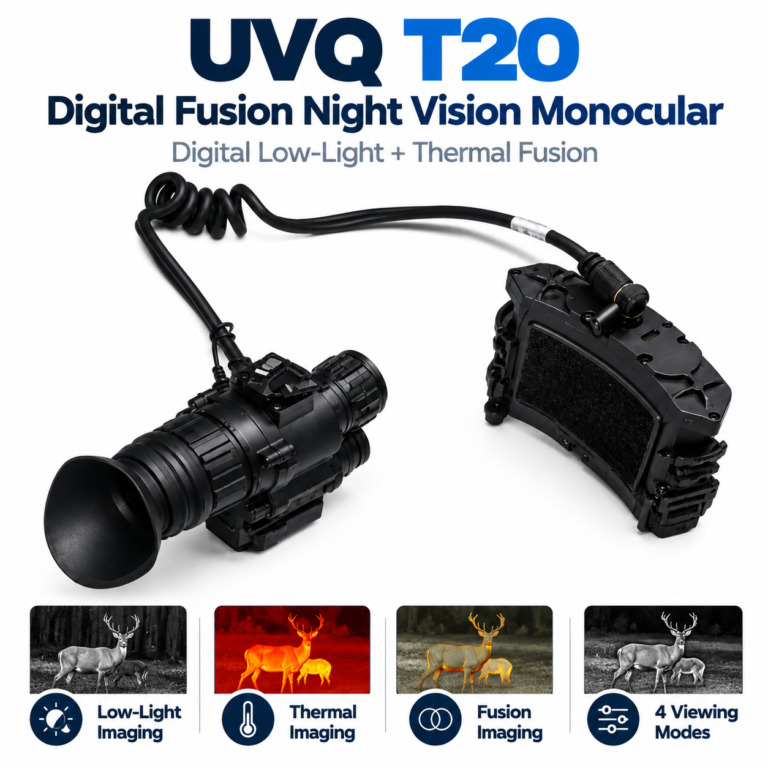
UVQ T20 weight and size are two of the first questions buyers ask when evaluating this digital fusion night vision system.
How heavy is it?
How big is it?
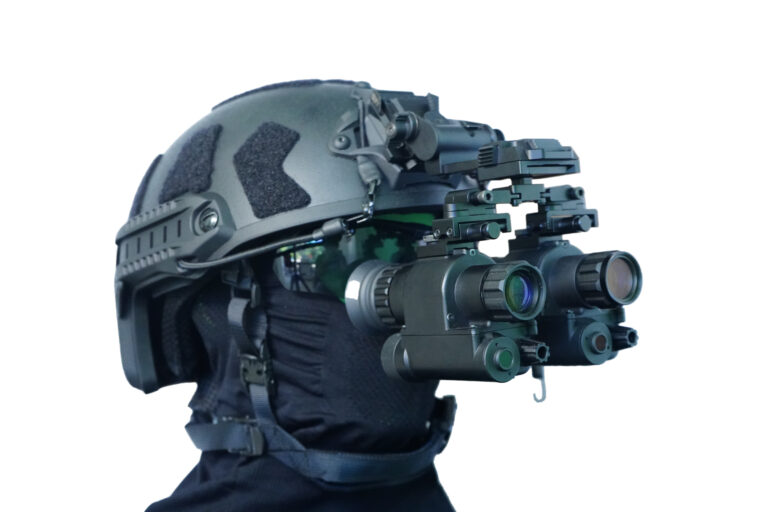
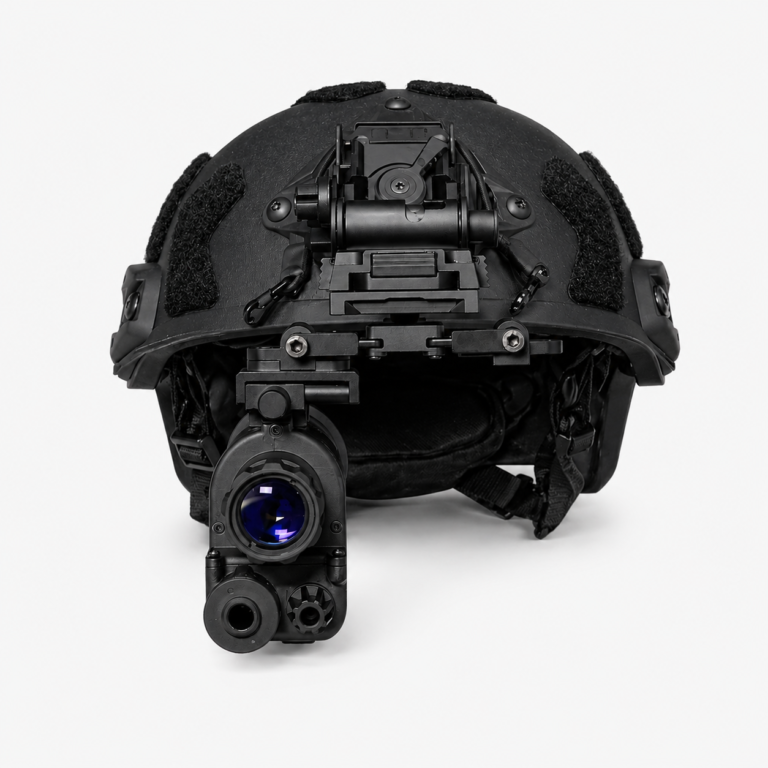
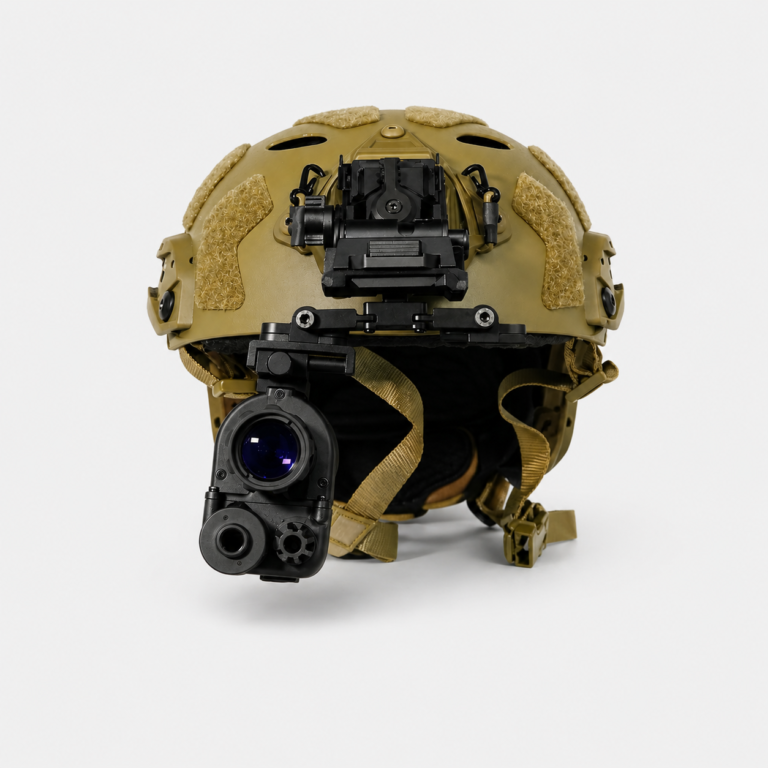
For helmet-mounted use, these questions matter even more because size and weight affect not only portability, but also balance, comfort, and system layout.
该 UVQ T20 is a digital fusion monocular that combines a low-light digital imaging channel with a thermal imaging channel. Unlike many compact handheld devices, the T20 uses a remote power architecture, which separates the front imaging unit from the rear battery pack.
This structure changes how the overall system is worn and understood. Instead of looking at only one number, buyers should look at the imaging unit, the battery pack, and the way weight is distributed across the helmet.
In this article, we use real measured sample photos to explain the actual size and weight of the UVQ T20.
Real Measured Weight of the UVQ T20
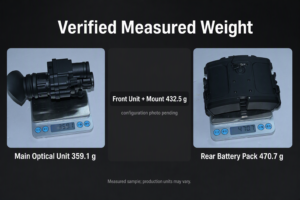
Based on the measured sample images:
- UVQ T20 imaging unit weight: 359.1 g
- UVQ T20 battery pack weight: 470.7 g
These are measured values shown in real photos, not only catalog numbers.
This distinction is important because many buyers want to know whether the front-mounted device is too heavy for headborne use. The T20 imaging unit itself is kept separate from the battery pack, so the front side and rear side can be considered independently.
Why this matters
For helmet-mounted systems, total system weight is only one part of the story.
该 distribution of that weight is equally important.
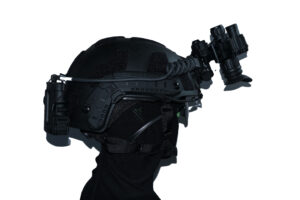
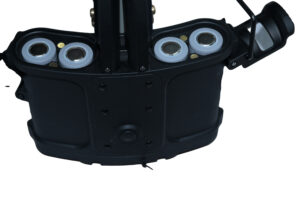
With the T20, the imaging unit is mounted at the front, while the battery pack is positioned at the rear. This helps reduce how much battery mass is concentrated in the front-mounted section.
UVQ T20 Imaging Unit Dimensions
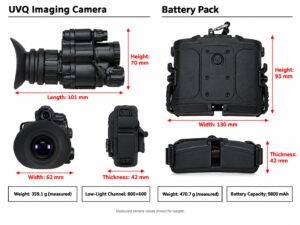
From the measured dimension image, the UVQ T20 imaging camera is approximately:
- Length: 101 mm
- Height: 70 mm
- Width: 62 mm
- Thickness: 42 mm
These dimensions help buyers understand the front profile of the device when mounted or handheld.
The imaging unit is compact enough for head-mounted integration, while still housing the low-light imaging channel and thermal fusion structure.
UVQ T20 Battery Pack Dimensions
该 rear battery pack is approximately:
- Width: 130 mm
- Height: 93 mm
- Thickness: 42 mm
The measured battery pack weight is:
- Weight: 470.7 g
And the graphic also shows:
- Battery Capacity: 9800 mAh
This confirms that the T20 is not using a small internal battery alone. Instead, it is designed around a more substantial external power module that supports the complete fusion system.
Why Does the UVQ T20 Use a Separate Battery Pack?
The T20 is designed with a remote power architecture.
That means the power source is separated from the imaging unit rather than being fully integrated into the front device body.
This design offers several practical advantages:
1. Better front-rear balance
The battery pack can be placed toward the rear of the helmet, helping offset front-mounted load.
2. Lower front-side burden
The imaging unit itself does not need to carry all battery weight inside the front housing.
3. Support for fusion system power needs
A thermal fusion device requires power not only for display and image processing, but also for the low-light channel, thermal channel, and system operation. A dedicated rear battery pack supports this architecture more effectively.
This does not mean the system is “lightweight” in a simplistic sense.
Instead, it means the system is designed with weight distribution in mind, which is a more useful way to evaluate helmet-mounted products.
How Should Buyers Interpret T20 Weight?
A common mistake is to compare all products using just one number.
For example, comparing the T20 only by total mass can be misleading, because the T20 is a fusion device with separate power architecture, not just a simple single-body monocular.
A better way to evaluate it is to ask:
- How much does the front imaging unit weigh?
- How large is the front device body?
- Where is the battery weight located?
- How is the system expected to be used — handheld or helmet-mounted?
In the case of the T20, the imaging unit is 359.1 g, while the battery pack is 470.7 g.
This makes it easier to understand how the system is physically arranged.
What Else Can We Learn From These Measurements?
The dimensions help show that the UVQ T20 is not an oversized bench device. It is a purpose-built fusion monocular system with a clearly separated front module and rear power module.
From a buyer’s perspective, these measurements are useful for:
- evaluating helmet compatibility
- planning carrying and storage space
- understanding front module size
- comparing structure against other digital or fusion systems
- explaining product architecture to dealers or end users
Real measured data also improves trust. Instead of using only general catalog descriptions, these sample images show actual measured size and weight information.
UVQ T20 at a Glance
Imaging Unit
- Weight: 359.1 g (measured)
- Length: 101 mm
- Height: 70 mm
- Width: 62 mm
- Thickness: 42 mm
Battery Pack
- Weight: 470.7 g (measured)
- Width: 130 mm
- Height: 93 mm
- Thickness: 42 mm
- Battery Capacity: 9800 mAh
Low-Light Channel
- Resolution shown in graphic: 800×600
常见问题
How much does the UVQ T20 weigh?
The measured sample shows the imaging unit at 359.1 g and the battery pack at 470.7 g.
What are the dimensions of the UVQ T20 imaging unit?
The imaging unit measures approximately 101 mm in length, 70 mm in height, 62 mm in width, and 42 mm in thickness.
Why does the T20 use a separate battery pack?
The T20 uses a remote power architecture to separate the front imaging unit from the power module, which helps support helmet-mounted balance and system power requirements.
Is the T20 designed for helmet-mounted use?
Yes. Its structure and remote power configuration are designed to support helmet-mounted applications.
What is the battery capacity of the T20 battery pack?
The dimension graphic shows a 9800 mAh battery capacity.
结语
The UVQ T20 is best understood as a complete fusion system, not just a single weight figure.
Its 359.1 g imaging unit, 470.7 g battery pack, and measured dimension data provide a clearer view of how the system is built and why its remote power structure matters.
For buyers evaluating thermal fusion monoculars, measured size and weight data are valuable because they help explain not only portability, but also how the system may perform in real helmet-mounted use.
If you want to learn more about the UVQ T20, contact UVQ for product details, dealer cooperation, or configuration support.


 English
 Chinese