Browse the full UVQ digital night vision range.
Platform Specifications
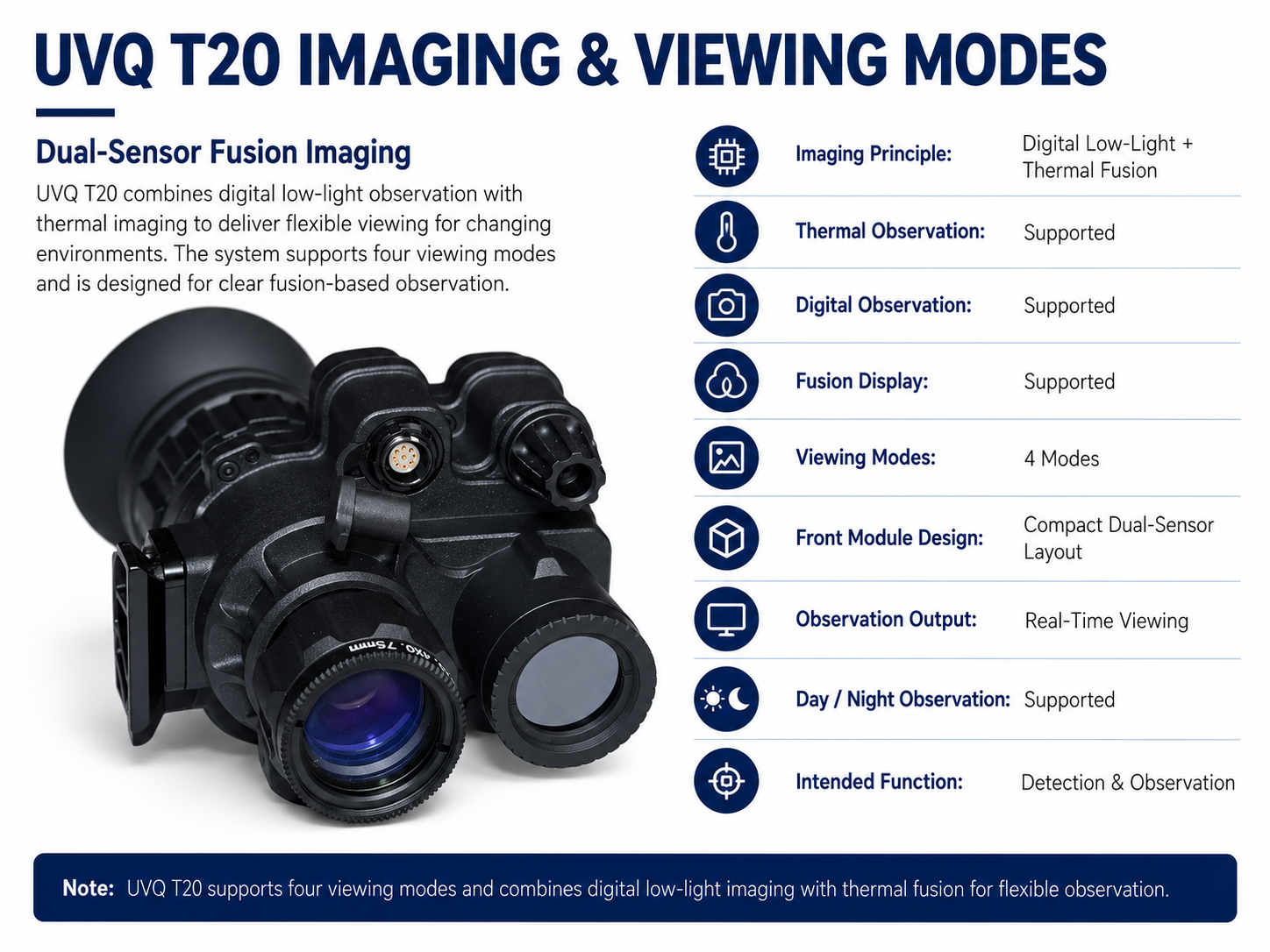
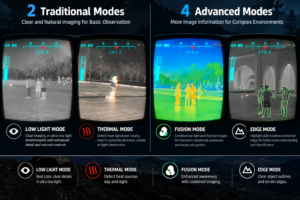
The UVQ T20 platform uses a digital low-light sensor of 1-inch CMOS with 18 μm pixel size, paired with a 640 × 512 thermal channel. Thermal sensitivity (NETD) is rated at 40 mK. The system provides four imaging modes: Fusion, Low-Light, Outline and Thermal.
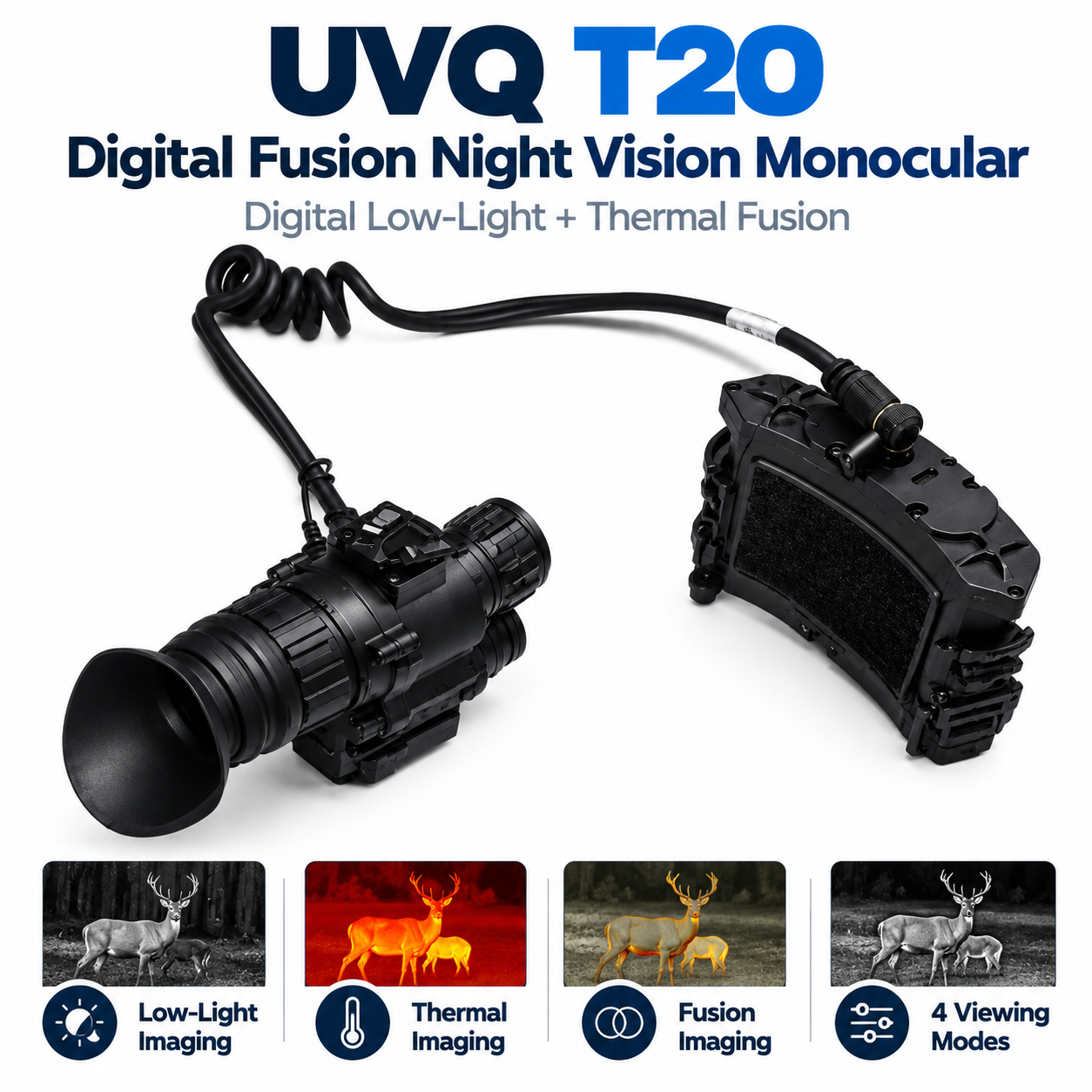
The UVQ T20 is a helmet-mounted digital fusion night vision monocular built around two complementary imaging channels: digital low-light imaging and thermal imaging.
Instead of relying on a single imaging method, the T20 combines visible low-light detail with thermal contrast, allowing the user to switch between different observation modes depending on the environment.
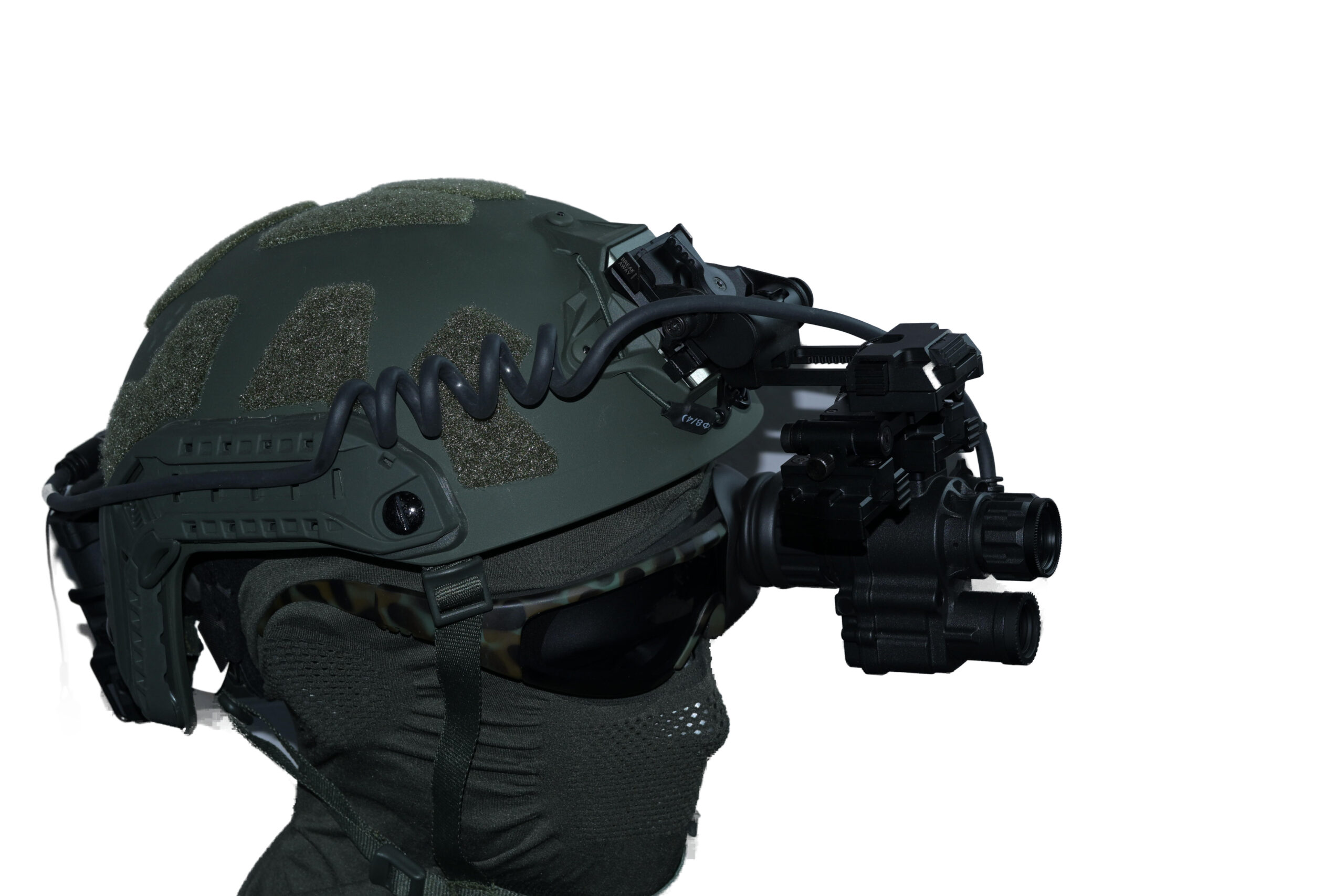
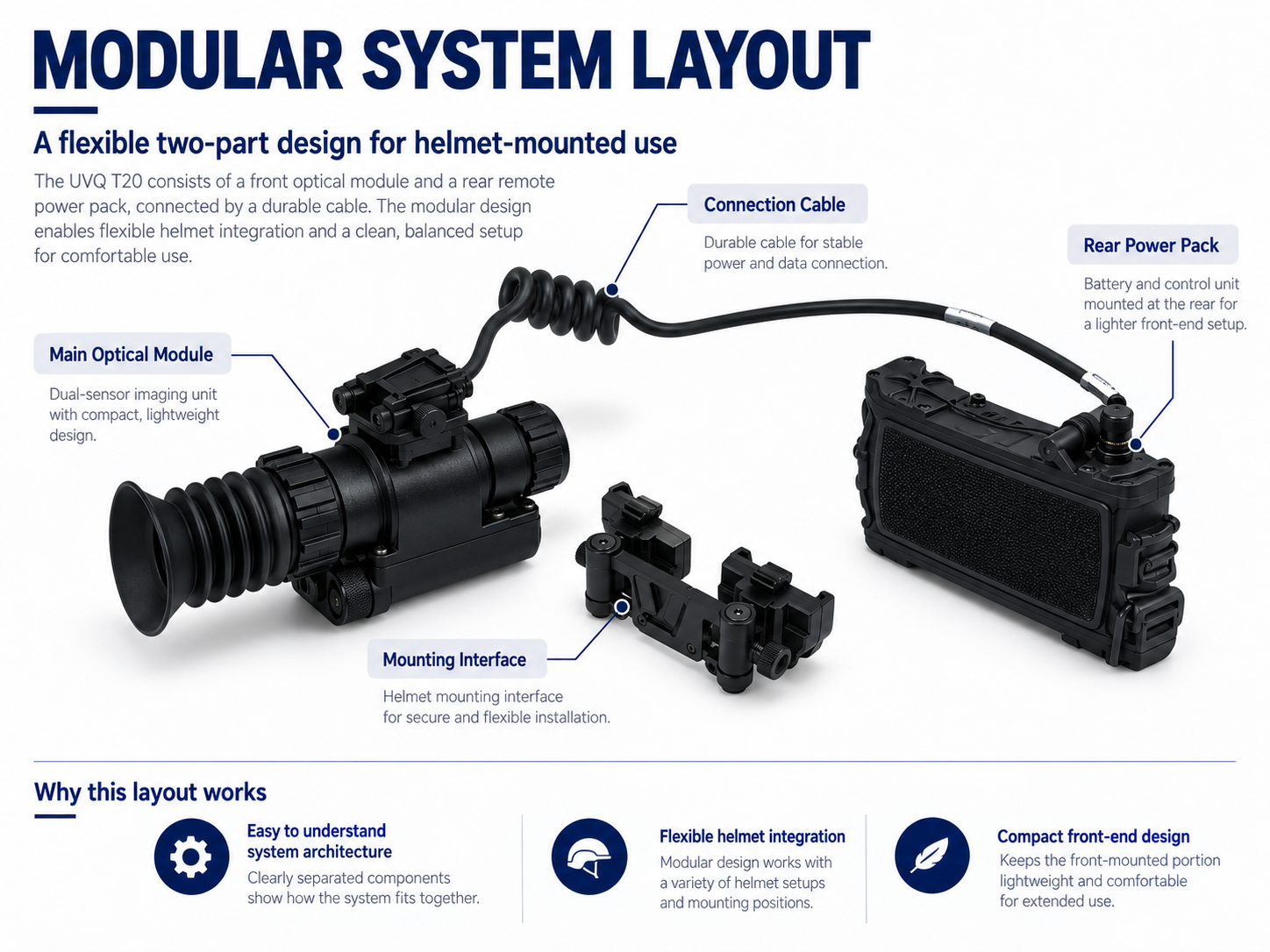
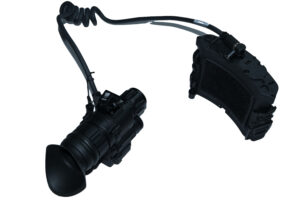
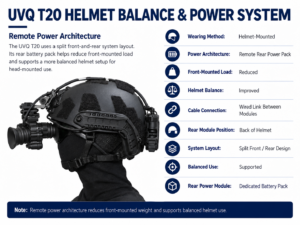
Its split front-and-rear architecture places the optical module at the front of the helmet and the dedicated power module at the rear. This remote power architecture reduces front-mounted weight and supports a more balanced helmet configuration.
Dual-Sensor Fusion Imaging
The T20 combines two different sources of visual information.
The digital low-light channel is designed to preserve scene structure, terrain detail, outlines, and visual context in low-light environments.
The thermal channel detects temperature differences and can make warm objects easier to distinguish when visible-light contrast is limited.
Fusion imaging combines information from both channels into one observation view.
This makes the T20 different from a conventional digital night vision monocular or a standalone thermal monocular: the user can access low-light information, thermal information, or a combined image from the same wearable system.
Low-light channel: 800 × 600
Thermal channel: 640 × 512
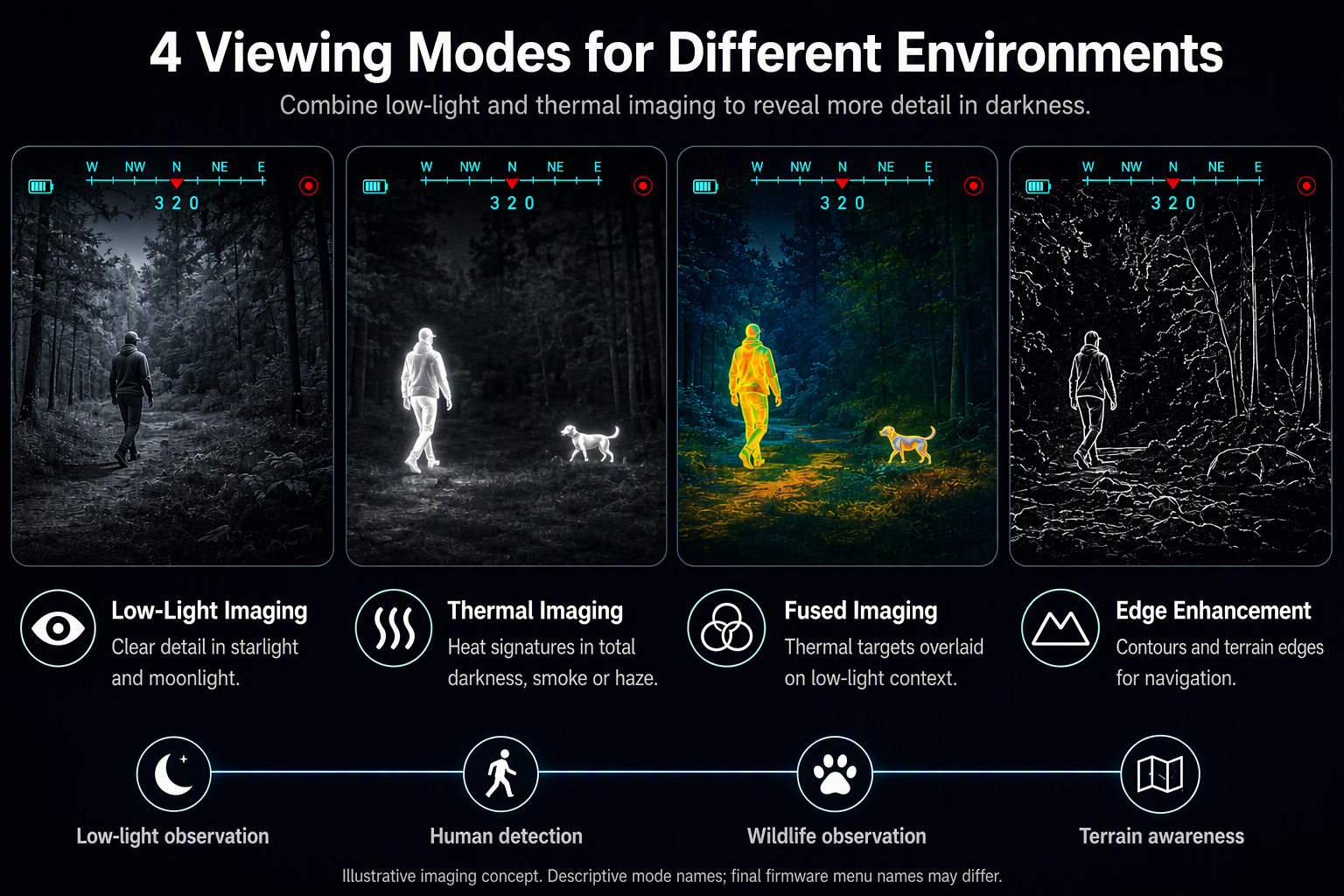
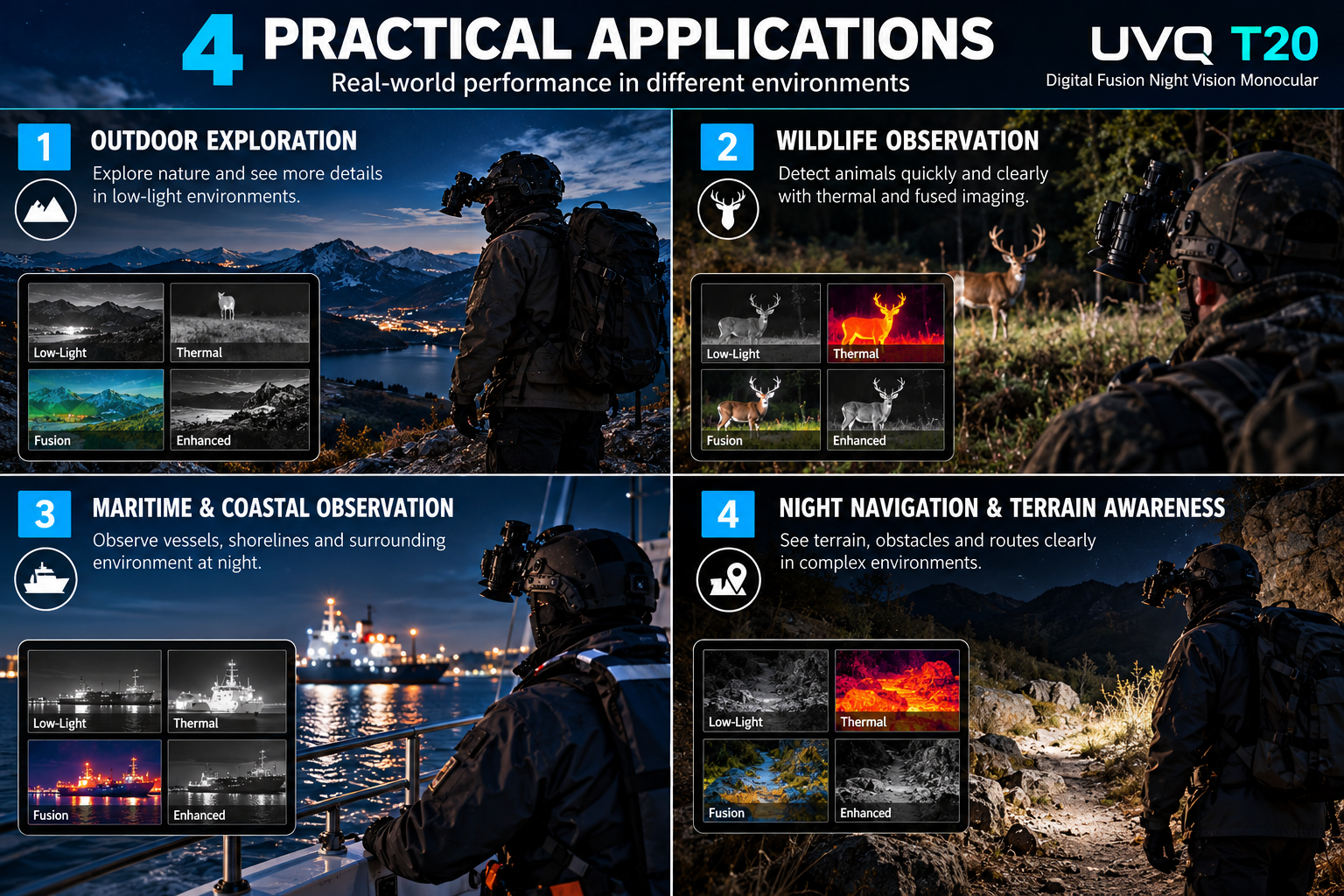
Illustrative imaging graphics on this page are used to explain the imaging principle and are not presented as actual through-device night footage unless specifically identified as real device output.
Four Viewing Modes
The UVQ T20 supports four viewing modes for different observation conditions.
Low-Light
Uses the digital low-light channel to preserve environmental detail and scene structure under limited ambient light.
Thermal
Uses thermal contrast to highlight temperature differences when visible-light information is limited.
Fusion
Combines thermal information with low-light scene context to provide more information in a single view.
Outline
Provides an additional image-processing mode for situations where contours, objects, or environmental structure need to be emphasized.
The availability of multiple imaging modes allows the user to adapt the system to changing conditions rather than relying on only one imaging channel.
Remote Power Architecture
One of the defining structural features of the T20 is its remote power architecture.
Instead of placing the complete battery system inside the front optical module, the T20 separates the system into:
- Main optical module
- Helmet mounting structure
- Connection cable
- Rear battery pack
The rear-mounted power module moves battery mass away from the front of the helmet.
Remote power architecture reduces front-mounted weight and supports balanced helmet use.
This layout also allows the optical section to remain more compact while supporting the power requirements of a dual-sensor fusion system.
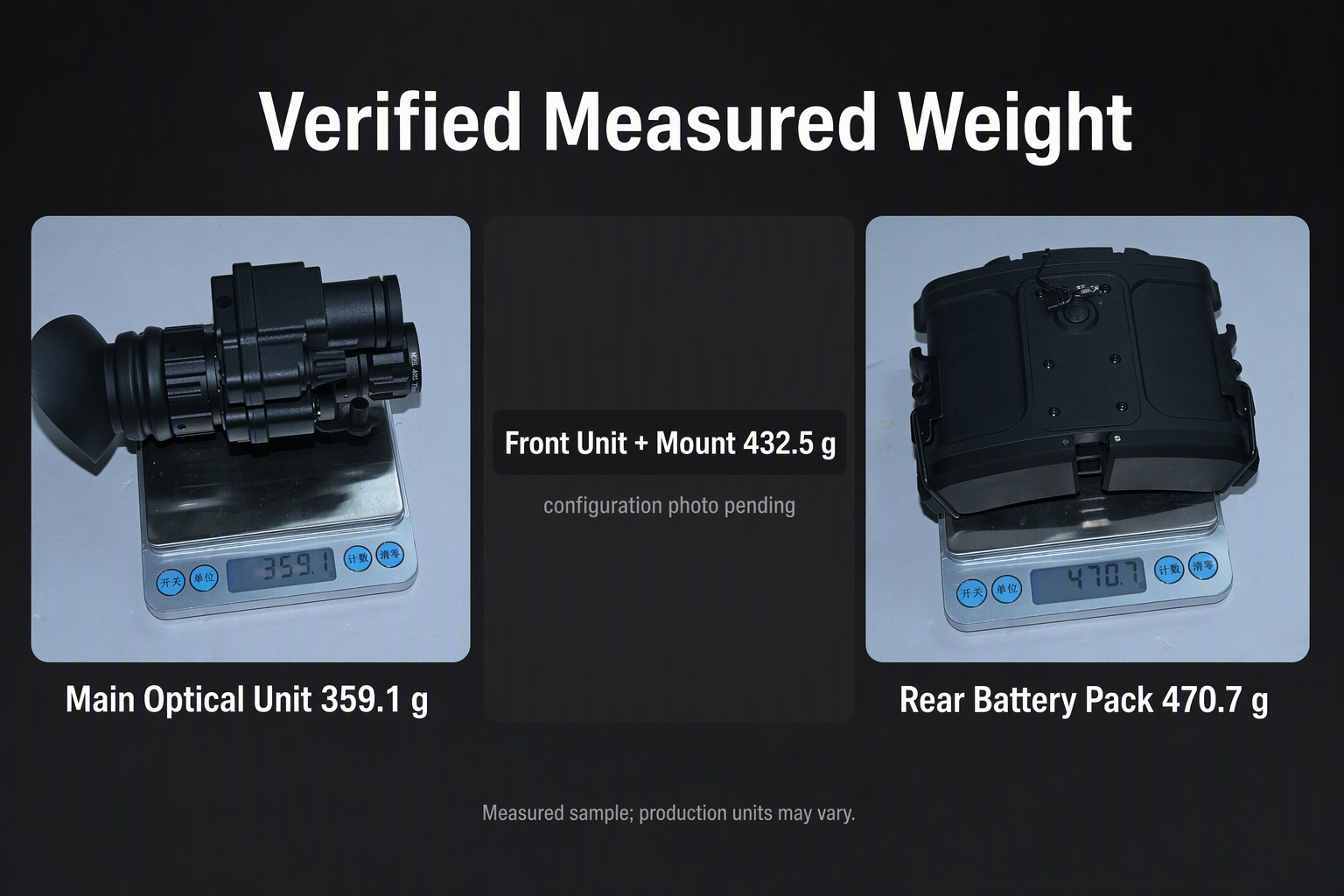
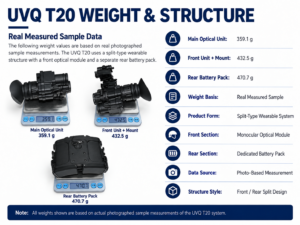
Real Measured Weight
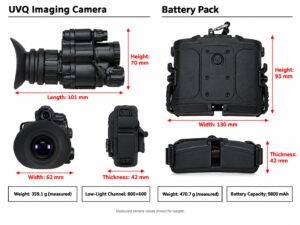
Rather than relying only on nominal specifications, the following values are based on photographed sample measurements.
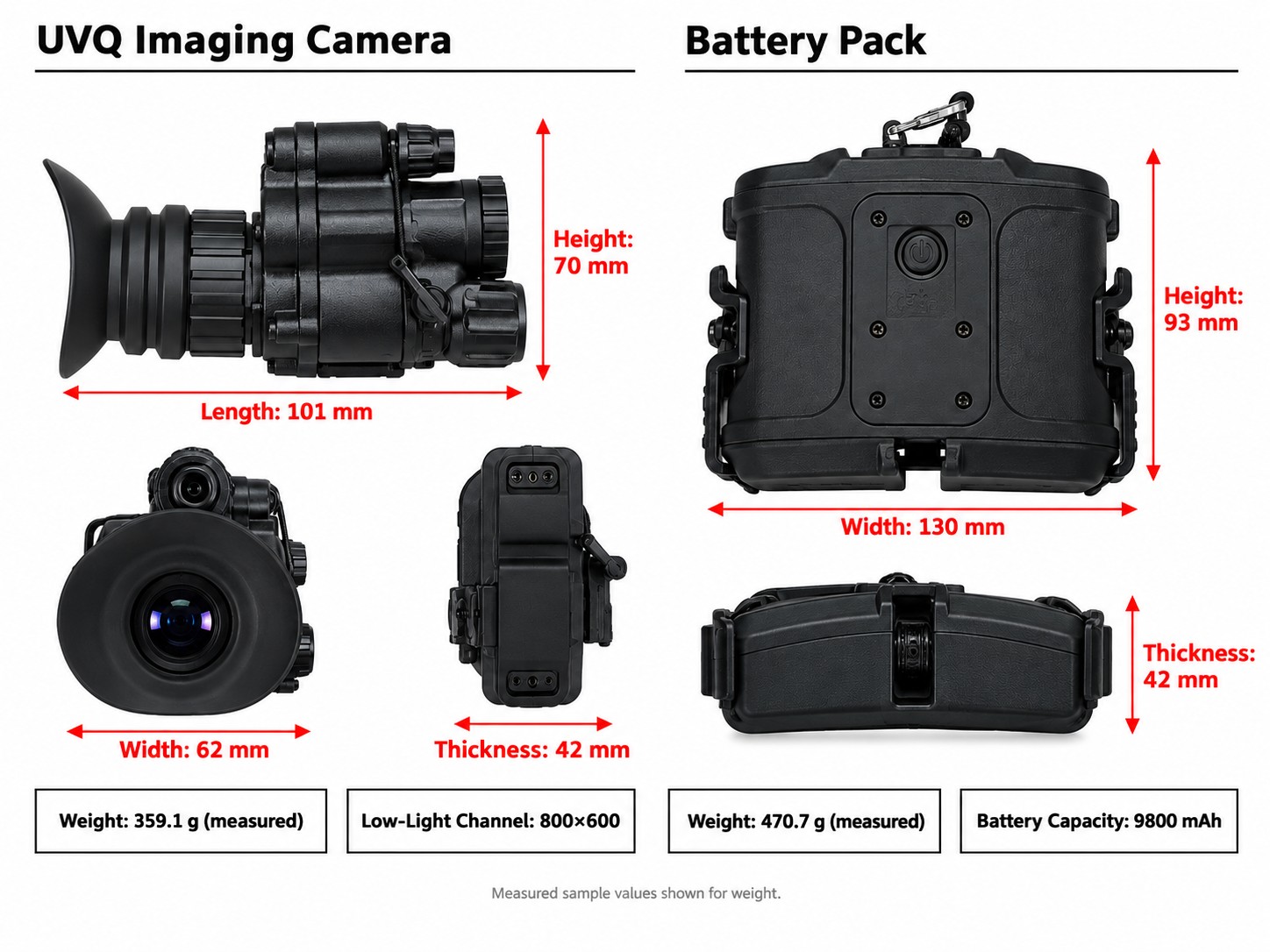
Main Optical Unit: 359.1 g
Main Unit + Mount: 432.5 g
Rear Battery Pack: 470.7 g
These figures show an important characteristic of the T20 system: the total system mass is distributed between the front optical section and the rear power section instead of being concentrated entirely at the front of the helmet.
Measured sample values are shown for reference. Production units may have minor variation.
Real Product Dimensions
Measured dimensions of the current T20 sample:
Main Optical Unit
Length: 101 mm
Width: 62 mm
Height: 70 mm
Thickness: 42 mm
Rear Battery Pack
Width: 130 mm
Height: 93 mm
Thickness: 42 mm
The separated layout allows the front optical module and rear power module to perform different functions while remaining part of one integrated wearable system.
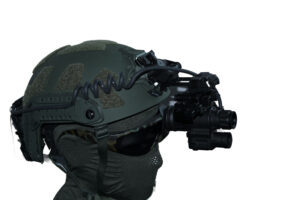
Helmet-Mounted System Layout
The UVQ T20 is designed around a split front-and-rear helmet configuration.
At the front:
- Main optical module
- Dual-sensor imaging section
- Eyepiece
- Helmet mounting interface
At the rear:
- Dedicated battery pack
- Rear-mounted power architecture
Between them:
- Wired connection
- Stable power link between the front and rear modules
This architecture is intended to reduce the amount of mass concentrated at the front of the helmet and provide a more balanced overall configuration.
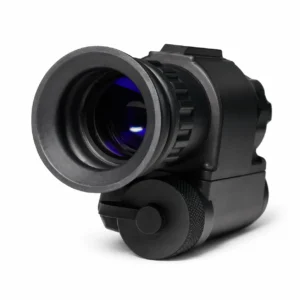
Main Optical Module
The front module contains the primary observation components of the system.
Its external structure includes:
- Diopter-adjustable eyepiece
- Low-light optical channel
- Thermal imaging channel
- Top controls
- Encoder/control interface
- External connection interface
- Helmet mounting interface
The front section is designed as a compact monocular observation module rather than a self-contained battery-heavy unit.
Rear Battery Pack
The rear module provides dedicated power support for the T20 system.
Its position at the back of the helmet serves two functions:
- Supplying power to the dual-sensor imaging system
- Moving battery mass away from the front-mounted optical unit
The battery pack is connected to the front module through a dedicated cable.
This front/rear layout is a core part of the T20 system architecture rather than simply an external accessory arrangement.
Modular Helmet Integration
The T20 uses a modular mounting structure designed for helmet-mounted observation.
The system includes separate front and rear components that work together as one wearable platform.
The modular layout allows the user to understand and manage each part of the system independently:
- Optical module
- Mounting interface
- Connection cable
- Rear power module
This structure also makes the overall architecture easier to inspect, maintain, transport, and integrate into a complete helmet setup.
Product Details
The T20 includes physical controls and connection points designed around wearable operation.
Key visible hardware features include:
- Adjustable eyepiece
- Optical adjustment rings
- Top-mounted controls
- External power/data connector
- Dedicated thermal imaging aperture
- Digital low-light optical channel
- Helmet mounting interface
- Rear power module connection
The physical layout keeps the imaging, mounting, control, and power functions clearly separated.
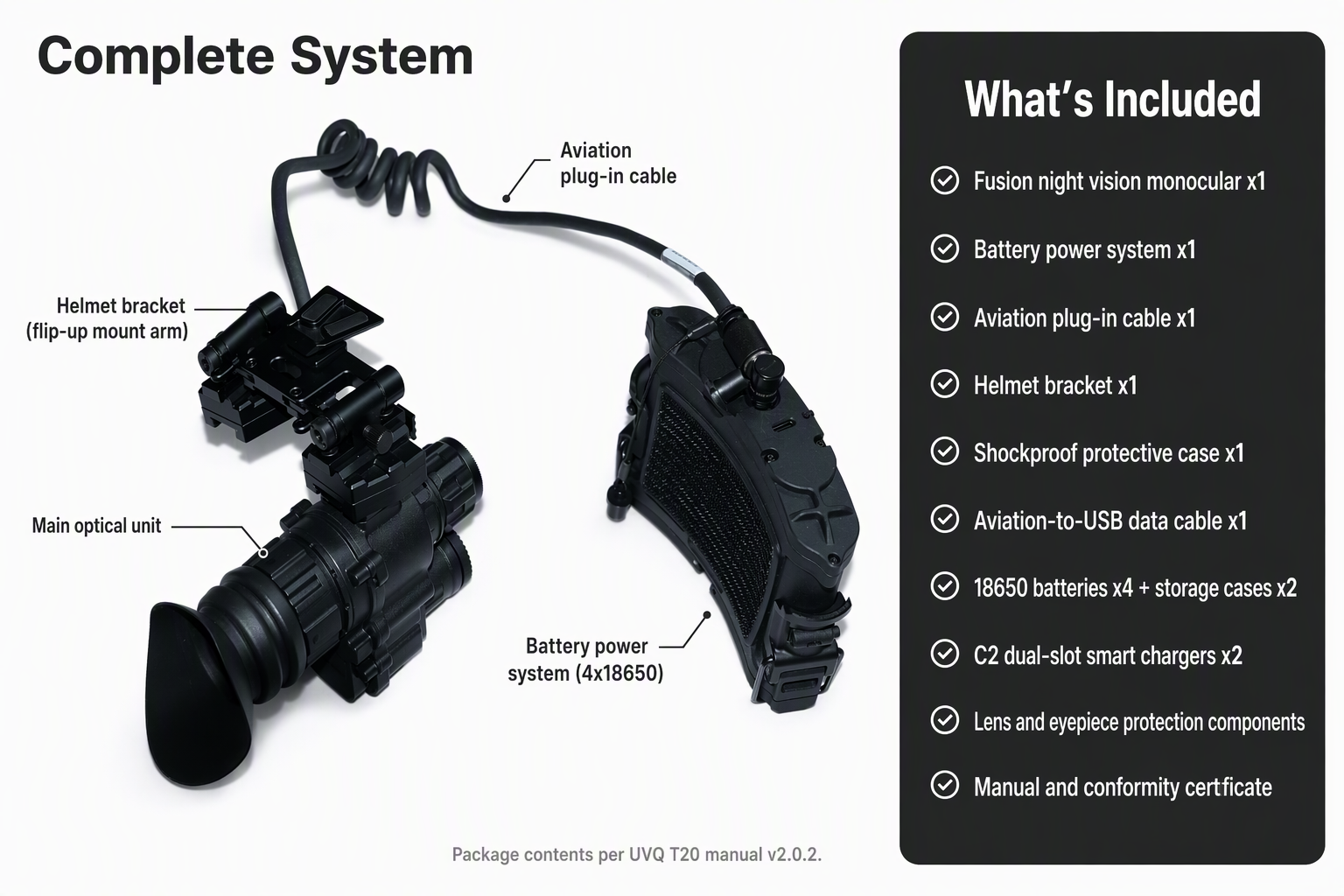
Complete System Configuration
A complete T20 system is built around the following primary components:
- UVQ T20 fusion night vision monocular
- Rear battery power system
- Connection cable
- Helmet mounting bracket
- Protective carrying solution
- Data connection accessories
- Battery and charging accessories
- Lens and eyepiece protection components
- User documentation
Exact package contents may vary according to order configuration. Confirm final package contents before ordering.
Why the T20 Uses a Split Front-and-Rear Design
For a helmet-mounted fusion system, total weight is only part of the story.
Where that weight is positioned also matters.
An all-in-one front-mounted system concentrates the optical components, electronics, and power source in front of the user’s face.
The T20 takes a different approach.
The optical unit stays at the front while the dedicated battery pack moves to the rear.
This creates three practical design advantages:
Reduced Front-Mounted Weight
The battery system is not concentrated inside the front optical module.
Better Weight Distribution
Part of the system mass is positioned toward the rear of the helmet.
Dedicated Power for Dual-Sensor Imaging
The rear power module supports the energy requirements of digital low-light and thermal fusion operation.
This architecture is one of the key differences between the T20 and conventional single-module digital night vision devices.
Who Is the UVQ T20 Designed For?
The T20 is designed for users and organizations looking for a wearable observation platform that combines digital low-light and thermal imaging.
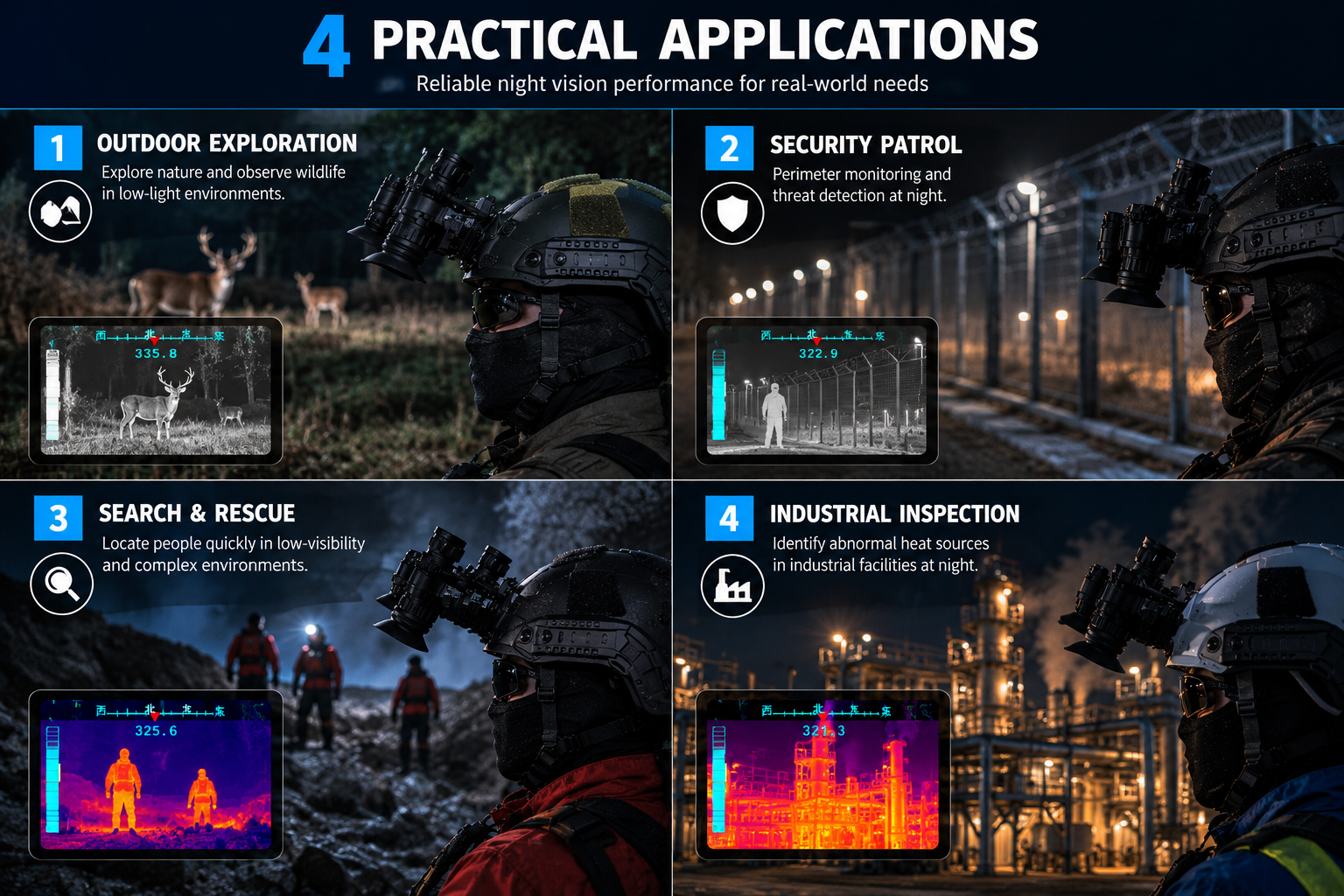
Typical use cases may include:
- Outdoor low-light observation
- Wildlife observation
- Nighttime navigation
- Search and inspection
- Security observation
- Equipment evaluation
- System integration
- Dealer and distributor programs
- OEM / ODM projects
Application suitability depends on local regulations and the user’s specific operating environment.
UVQ T20 at a Glance
Product: UVQ T20 Digital Fusion Night Vision Monocular
Imaging architecture: Digital low-light + thermal fusion
Viewing modes: 4 modes
Configuration: Front optical module + rear battery pack
Power layout: Remote power architecture
Helmet use: Supported
Main optical unit weight: 359.1 g measured sample
Front unit + mount: 432.5 g measured sample
Rear battery pack: 470.7 g measured sample
Main unit dimensions: 101 × 62 × 70 mm
Rear battery pack dimensions: 130 × 93 × 42 mm
Low-light channel: 800 × 600
Thermal channel: 640 × 512
Helmet-Mounted Front and Rear Architecture
The T20 separates the imaging system and power system into two main sections.
A connection cable links the two modules into one integrated wearable system.
This structure avoids concentrating the optical electronics and battery mass in one front-mounted housing.
Remote Power Architecture
The UVQ T20 uses a dedicated rear power module rather than placing the full battery system inside the front optical unit.
Positioning the battery module behind the helmet allows the power source to contribute to front/rear weight distribution instead of adding additional mass to the front optical module.
The cable enables the two separated modules to operate as one integrated system while allowing the optical and power sections to remain physically independent.
Designed for Helmet-Based Observation
For helmet-mounted equipment, total system weight is only one part of the equation. Weight distribution also affects how the system feels when worn.
Frequently Asked Questions
How is the T20 powered?
The T20 uses a remote power architecture, with a separate front optical module and rear battery pack connected by a dedicated cable.
What are the resolutions of the T20?
Low-light channel: 800 × 600. Thermal channel: 640 × 512.
What is the weight of the T20?
Measured sample: approximately 359.1 g (front optical module) and 470.7 g (rear battery pack). Values may vary slightly between units.
Does the T20 support iOS?
No. Wi-Fi currently supports Android only.
What viewing modes does the T20 support?
Low-Light, Thermal, Fusion, and Outline.
Can I request a quote for the T20 OEM version?
Yes. The OEM version is available on a price-on-request basis.
The T20 is designed as a complete wearable platform rather than a standalone handheld monocular.
For Dealers, Distributors and OEM Projects
UVQ supports B2B inquiries for T20 product evaluation, distribution, wholesale supply, and OEM/ODM cooperation.
For pricing, quantity requirements, dealer support, or custom integration discussions, contact UVQ with your target market, estimated quantity, and intended application.
UVQ focuses on real product data, real measurements, and transparent technical communication.
Warranty: 1 Year Limited Warranty
Related products
-
Monoculars
UVQ G14 Professional Digital Night Vision Monocular with Rail Mount
$1,199.00 Add to cart


 English
 Chinese
Reviews
There are no reviews yet.